
Interdisciplinary pathways to sustainable rural development: Culture, community, and evidence-based practice
Keywords:
community development, indigenous knowledge, poverty, public health, rural developmentAbstract
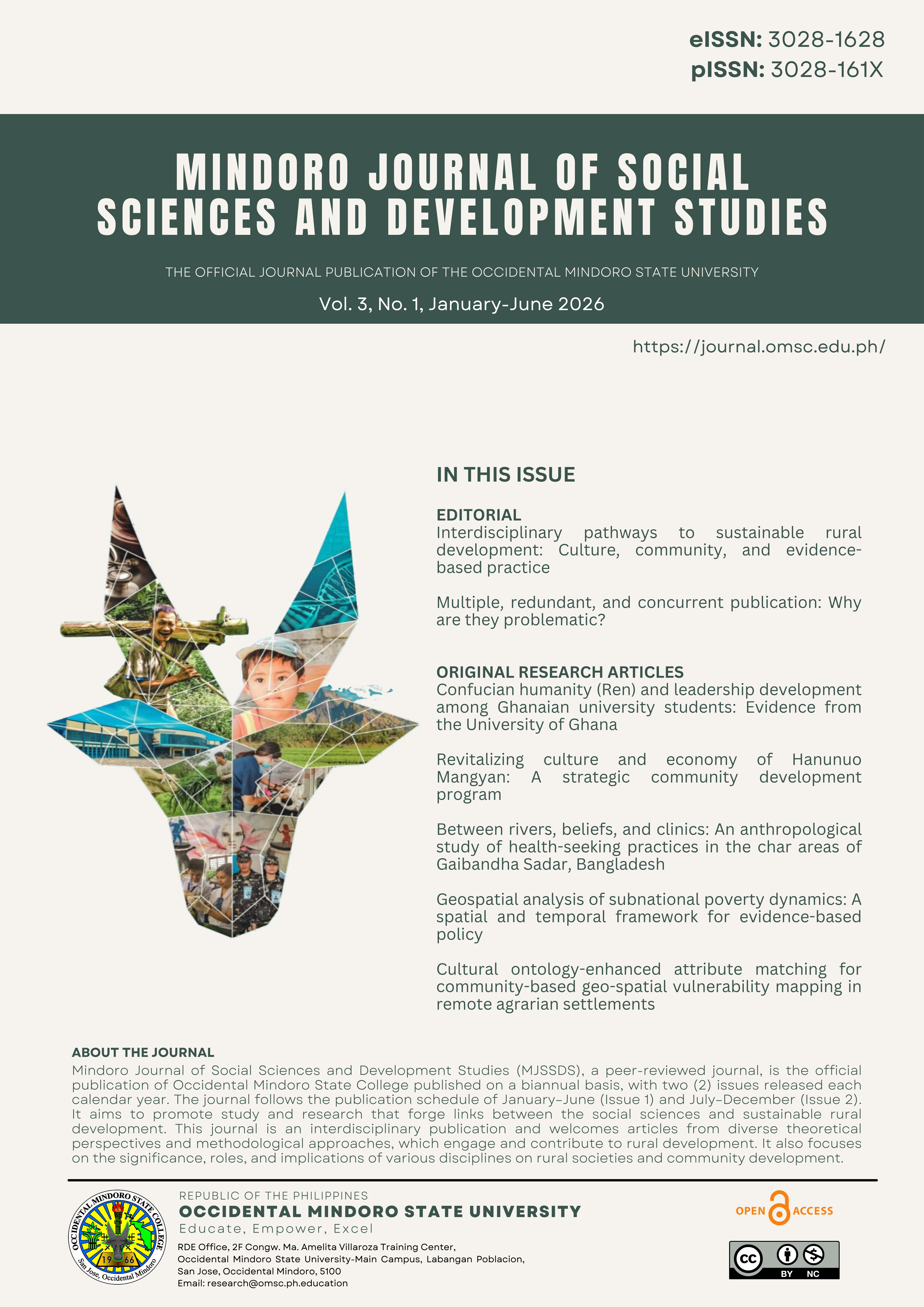
This issue advances the mission of the Mindoro Journal of Social Sciences and Development Studies to link social science research with sustainable rural development. The articles in this issue apply interdisciplinary approaches to examine how culture, knowledge systems, and spatial data inform community development, public health, and policy in rural and marginalized settings.
The study on Confucian humanity among Ghanaian university students contributes to rural sociology and education by examining how ethical values shape social responsibility and future leadership roles. While students express strong support for care and respect for the elderly, the weak link to leadership development points to the need for structured programs that translate values into community-based leadership practice.
The research on the Hanunuo Mangyan community directly addresses indigenous knowledge, rural livelihood, and community development. Through ethnographic methods, the study identifies sectoral strengths in agriculture, culture, and tourism, while highlighting gaps in education and governance. The proposed strategic plan provides a clear model for community extension and evidence-based rural development.
The anthropological study in Bangladesh contributes to public health in rural areas by showing how geographic isolation, cultural beliefs, and limited infrastructure shape health-seeking behavior. The findings support the design of accessible and culturally responsive health services, including mobile care and improved referral systems in vulnerable rural communities.
The geospatial analysis of poverty in Sri Lanka aligns with rural economics and policy development. By mapping subnational disparities, the study shows that poverty reduction is uneven across local areas. This approach supports targeted interventions and strengthens the role of spatial data in rural planning and resource allocation.
The final article presents a methodological contribution to rural infrastructure and technology. It integrates indigenous knowledge with geospatial analysis to improve vulnerability mapping in agrarian communities. The results show better alignment between local perceptions and technical models, supporting more accurate and context-sensitive decision-making.
Across all studies, this issue highlights a central goal of the journal. Effective rural development requires interdisciplinary research that integrates cultural insight, local knowledge, and empirical data. These contributions provide practical evidence to support policies and programs that are responsive to the realities of rural communities.
References
Downloads
Published
Issue
Section
License
Copyright (c) 2026 Artemio M. Gonzales Jr. (Author)

This work is licensed under a Creative Commons Attribution-NonCommercial 4.0 International License.